Rooted in Place: The Case for Building American Theater From the Ground Beneath It
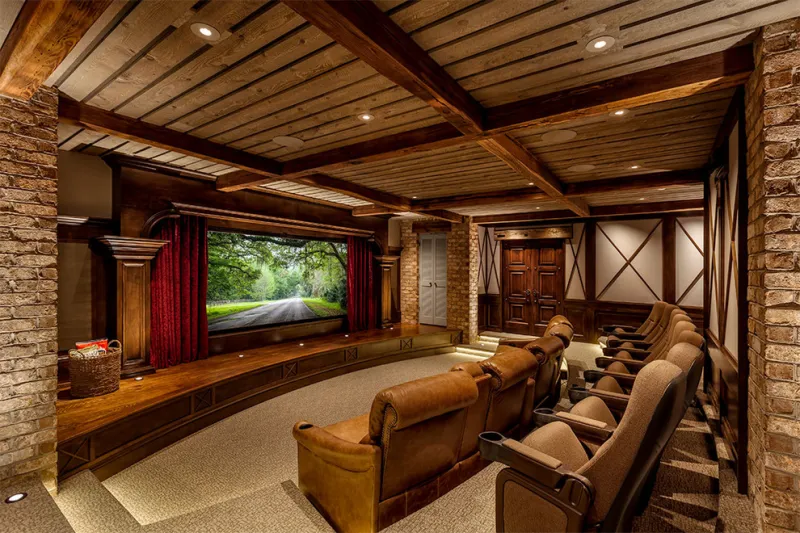
Photo: rustic wooden theater performance space built from natural stone and reclaimed timber, via st.hzcdn.com
The standard American regional theater is, in many respects, a building designed to be anywhere. Its fly tower, its grid of lighting instruments, its retractable seating and climate-controlled lobbies — these are the features of a facility engineered for versatility and operational efficiency. They are also, by design, features that could belong to a theater in Minneapolis or Miami, in Denver or Detroit, with almost no modification. The building does not know where it is. And some would argue that this geographical amnesia is part of why audiences sometimes feel, despite the best efforts of the artists inside, that they are watching something that does not quite belong to them.
In the Carpathian highlands, theaters are built differently — not always by formal design, but by cultural inheritance. Performance spaces in this tradition are assembled from what the landscape provides: timber hewn from local forests, stone quarried from nearby hillsides, materials that carry in their grain and texture the specific character of the place they came from. The result is a space that does not merely house performance but embodies it — a venue that is itself a kind of argument about where, and why, theater happens.
The Carpathian Principle of Material Honesty
In Carpathian theatrical and folk performance traditions, the relationship between performance and environment has never been abstract. Village stages, ceremonial gathering spaces, and the outdoor performance grounds used for seasonal festivals were not constructed as neutral containers for artistic content. They were built to reflect and reinforce the community's relationship to its particular landscape. The wood used in their construction came from forests that the community knew by name. The stone came from outcroppings that appeared in local stories and songs. The space was, in a meaningful sense, made of the same substance as the culture it served.
This principle — which might be called material honesty — is now attracting serious attention from American theater practitioners who are questioning the dominant model of the purpose-built venue. The questions they are asking are both practical and philosophical: What does a theater owe to the community and landscape it occupies? Does the material character of a performance space affect the quality of what occurs within it? And in an era of heightened environmental consciousness, what does it mean to build a cultural institution from extracted and manufactured materials when local and reclaimed alternatives exist?
American Companies Taking Root
Several American theater companies have begun answering these questions with concrete action. In rural Vermont, a newly established ensemble spent its first two seasons performing in a converted barn before undertaking a deliberate renovation that used timber salvaged from a collapsed mill on the same property, fieldstone gathered from the surrounding land, and hand-forged hardware produced by a local blacksmith. The company's artistic director, speaking at a regional theater conference last year, described the renovation as an artistic decision as much as a practical one.
"We wanted the building to feel earned," she explained. "Not just environmentally responsible — though that matters — but earned in the sense that the space had a relationship with the ground it stood on. Actors notice it. Audiences notice it. There is a quality of presence in a room built from real materials that you simply cannot manufacture with drywall and stage paint."
A similar ethos has guided the development of a small theater collective in northern New Mexico, where the company has constructed a performance pavilion using adobe, reclaimed vigas, and stone sourced from a nearby arroyo. The founders explicitly cite Carpathian theatrical philosophy as an influence, noting that their research into Eastern European folk performance spaces convinced them that the American tendency to separate the built environment from the natural one was costing theater companies something irreplaceable.
The Environmental and Community Dimensions
The argument for locally sourced and reclaimed construction materials is not purely aesthetic. It intersects with a broader conversation about the environmental responsibilities of cultural institutions, a conversation that has gained considerable urgency in recent years. Theater buildings are significant consumers of energy and materials, and the construction of new purpose-built venues carries a substantial carbon footprint. Companies that choose to work within existing structures, or to build with reclaimed and local materials, are making a statement about their values that extends well beyond the stage.
There is also a community dimension to this approach that aligns closely with the Carpathian model. When a theater is built from materials gathered in its immediate region, it creates economic and relational connections with local suppliers, craftspeople, and landowners. The building becomes a record of those relationships. It carries the labor of the community in its walls. This is not a metaphor; it is a material fact, and audiences who understand it experience the space differently.
Research in environmental psychology supports the intuition that material authenticity affects human perception and behavior. Spaces constructed from natural and locally sourced materials tend to generate higher levels of what researchers call "place attachment" — the sense that a space is meaningful, distinctive, and worthy of care. For theater companies struggling to build loyal audiences in an era of abundant competing entertainment, place attachment is not a trivial consideration.
What the Stage Itself Communicates
There is a final, more elusive argument for the Carpathian approach to theatrical construction, and it concerns the relationship between the performer and the space they inhabit. Experienced actors frequently report that performing in spaces with genuine material character — old wood, rough stone, surfaces that have absorbed years of human presence — produces a quality of groundedness that manufactured environments rarely replicate. The space seems to collaborate with the performance rather than simply contain it.
This is difficult to quantify, and theater practitioners are often reluctant to make claims that cannot be empirically demonstrated. But the consistency of the testimony is striking. Directors who have worked in Carpathian-influenced spaces, and in the highland performance venues that inspired them, return repeatedly to the same language: presence, weight, authenticity, belonging.
For American theater, a field perpetually navigating the tension between accessibility and depth, between broad appeal and genuine artistic integrity, these are not small words. They point toward a conception of the performance space as something more than a technical facility — as a participant in the act of theater itself, speaking quietly but persistently of the place and people from which it was made.