From the Carpathians to the Rehearsal Room: A Director's Working Guide to Mountain-Born Stagecraft
For years, conversations about Carpathian theater in American arts circles have tended toward the reverential and the abstract. Audiences are told that something ineffable lives in these mountain-born productions — a quality of presence, a gravitational pull toward stillness, a sense that every performer on stage is breathing as one organism. What has been discussed far less frequently is how that quality is actually made. Carpathian theatrical practice is not mysticism dressed in embroidered linen. It is a rigorous, transmissible craft, built from specific techniques that directors can study, practice, and carry directly into their next production.
What follows is a working guide to several of those techniques — drawn from the rehearsal traditions of Prykarpattia and the broader Carpathian theatrical world — examined not as cultural artifacts but as practical instruments.
Spatial Composition: The Stage as a Living Landscape
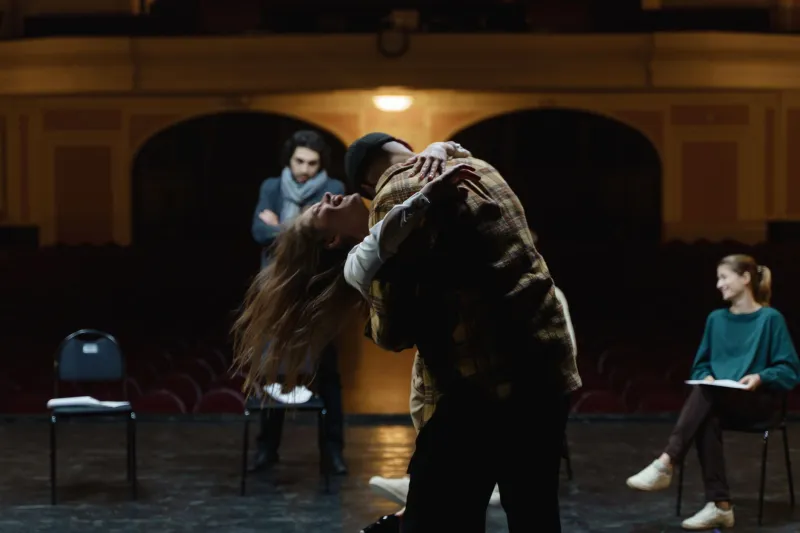
In much of mainstream American regional theater, blocking is treated primarily as a traffic-management problem. Actors must be seen, sightlines must be preserved, and entrances and exits must be choreographed cleanly. Carpathian directors approach the stage from an entirely different premise: that spatial relationships between bodies are themselves a form of language, capable of carrying dramatic meaning independently of dialogue.
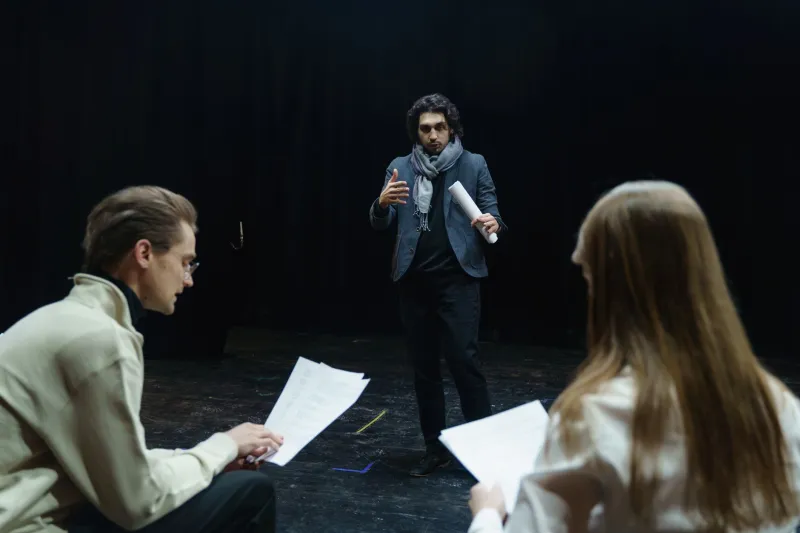
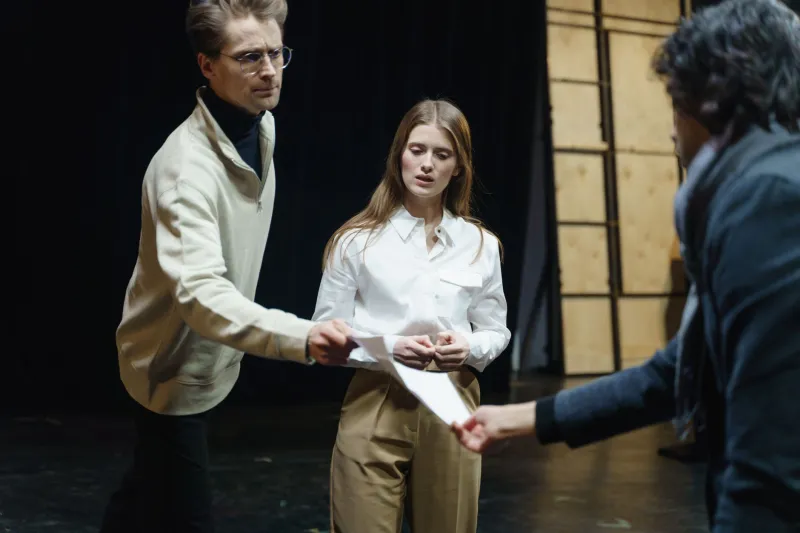
The technique begins in the earliest stages of rehearsal with what Carpathian practitioners call terytoriia — loosely translated as "territory work." Actors are placed on stage without scripts and asked to respond to one another purely through proximity. The director does not assign positions. Instead, the ensemble is guided to feel the magnetic pulls and repulsions between characters as physical forces. A scene between two estranged siblings, for instance, might be rehearsed entirely through spatial negotiation before a single line is spoken.
For American directors, the practical application is accessible. In early table work sessions, before staging begins, ask actors to stand and physically occupy the emotional geography of a scene. Who gravitates toward whom? Who maintains maximum distance? Who circles the periphery? Allow those instincts to inform your blocking rather than overwriting them with predetermined positions. The result is staging that feels organic because, in a real sense, it is.
Rhythm Architecture: Structuring Time Rather Than Action
Carpathian dramatic tradition draws heavily from folk ritual, and ritual is fundamentally a technology for organizing time. Where Western theatrical training often focuses on the arc of action — what happens and in what order — Carpathian directors think first about the architecture of rhythm. A production is understood as a sequence of temporal textures: passages of compression and expansion, acceleration and suspension, density and breath.
The practical tool here is the ritmichna mapa, or rhythm map — a score of the production written not in terms of plot events but in terms of pace and weight. A director working in this tradition might describe the first act not as "the exposition" but as "a long intake of breath with two moments of sudden constriction." The second act might be charted as "three waves of increasing speed breaking against a sustained stillness at the climax."
American directors can begin building this skill by taking a production they know well and re-reading it purely for its temporal dynamics. Strip away character and story and ask only: where does this text want to move quickly, and where does it want to rest? Once that map exists, it becomes a rehearsal tool — a guide for working with actors on the internal tempo of individual scenes rather than simply their emotional content.
Ensemble Breathing: The Invisible Choreography
Perhaps no Carpathian technique generates more initial skepticism from American theater practitioners — and more conviction once experienced — than ensemble breathing. The concept is straightforward: in Carpathian ensemble training, performers are taught to synchronize their breathing patterns during performance, not mechanically but as an extension of shared attention. When the ensemble breathes together, the audience, without knowing why, feels it.
The physiological basis is well-documented in performance studies. Human beings are exquisitely sensitive to respiratory cues in others. When a group of performers inhales together before a significant moment, audiences unconsciously mirror that intake. The effect is a shared suspension — a collective leaning in — that no amount of dramatic lighting can fully replicate.
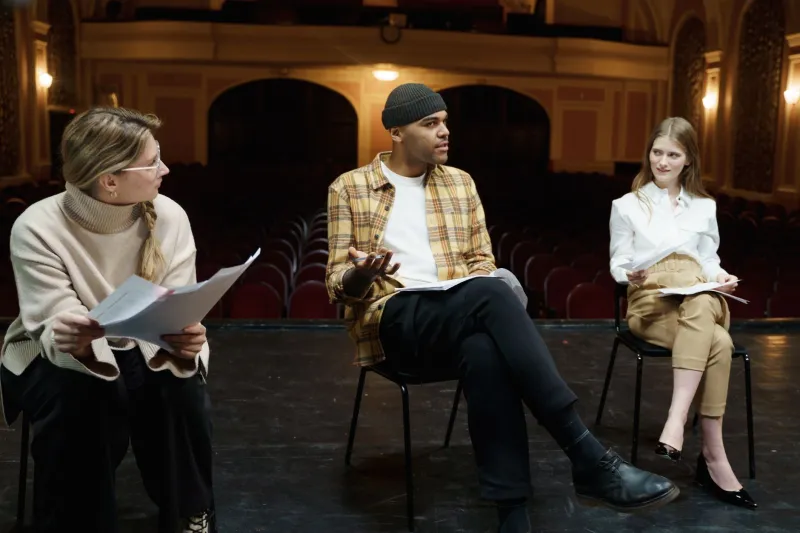
The rehearsal practice is simple to introduce. Begin each run-through with what Carpathian directors call a spilne dyshannia exercise: the full company stands in a loose circle and breathes together for three to five minutes, with no instruction beyond awareness. Over time, this shared respiratory consciousness begins to carry into the work itself. Directors who have introduced this practice in American rehearsal rooms — at regional theaters in the Midwest and on university stages across the Southeast — consistently report that it reshapes the quality of ensemble listening in ways that notes and discussion cannot.
Threshold Moments: The Architecture of Transition
Carpathian theatrical tradition places extraordinary emphasis on what happens between scenes — the transitions, the silences, the moments of passage. In folk performance from the Prykarpattia region, these thresholds are treated as structurally significant events, not merely as logistical gaps to be minimized. The move from one world to another is understood as a dramatic act in itself.
The technique that emerges from this philosophy is called porig robota, or threshold work. Rather than staging transitions as efficiently as possible, directors trained in this tradition spend substantial rehearsal time on the quality of passage: how does the stage exhale after a scene ends? How does the next scene gather itself before it begins? Lighting, sound, and physical stillness are all instruments of this threshold composition.
For American directors working in regional houses where production schedules are tight and transition time is often the first thing cut, this principle can be applied in miniature. Even within scenes, ask: where are the interior thresholds? Where does one emotional register give way to another? Rehearsing those micro-transitions with the same care given to major dramatic beats will deepen the texture of any production.
Bringing the Toolkit Home
None of these techniques requires a director to have studied in Lviv or staged a production in the foothills of the Carpathians. They require only a willingness to approach the rehearsal room as a laboratory rather than a production line — to treat the making of theater as a practice of discovery rather than a process of execution.
What Carpathian theatrical tradition offers American directors is not a foreign aesthetic to be imported wholesale, but a set of precise instruments for solving problems that every director faces: how to make a stage feel alive, how to make an ensemble feel unified, how to make time feel shaped rather than simply elapsed.
These are old questions. The Carpathian mountains have been offering answers for a long time. The rehearsal room is waiting.